Give Your Zakat
Fulfil your sacred obligation. Your Zakat purifies your wealth and transforms lives.
What is Zakat?
Zakat is one of the five pillars of Islam. It is an obligatory act of worship for every sane, adult Muslim who owns wealth equal to or above the Nisab, beyond their basic needs and debts, for one full lunar year. The amount due is 2.5% (one-fortieth) of that wealth. It is not merely a charitable recommendation but a divine commandment that purifies one's wealth and blesses what remains.
The Qur'an names eight categories of Zakat recipients (Qur'an 9:60): the poor, the needy, those employed to collect it, those whose hearts are to be reconciled, freeing captives, those in debt, in the cause of Allah, and the stranded traveller. As a charitable trust, Daan Foundation distributes Zakat to the poor and the needy.
Zakat in the Light of the Qur'an
Allah says in the Qur'an: "And those in whose wealth there is a known right, for the one who asks and the one who is deprived." (Qur'an 70:24-25). This verse reminds us that wealth is a trust from Allah, and embedded within it is a right that belongs to those who are in need.
Allah mentions Zakat together with Salah in many verses of the Qur'an, showing that caring for those in need is part of worship itself.
How Daan Foundation Uses Zakat
Community Kitchen
A full plate of food handed to each eligible person as their own
Ration Kits
Food supplies given to eligible families as their own
Clothing Support
Clothing given to eligible recipients
Medical Assistance
Medical help given to, or on behalf of, eligible recipients
Educational Support
School supplies and fees for eligible children
Community Kitchen & Food Support
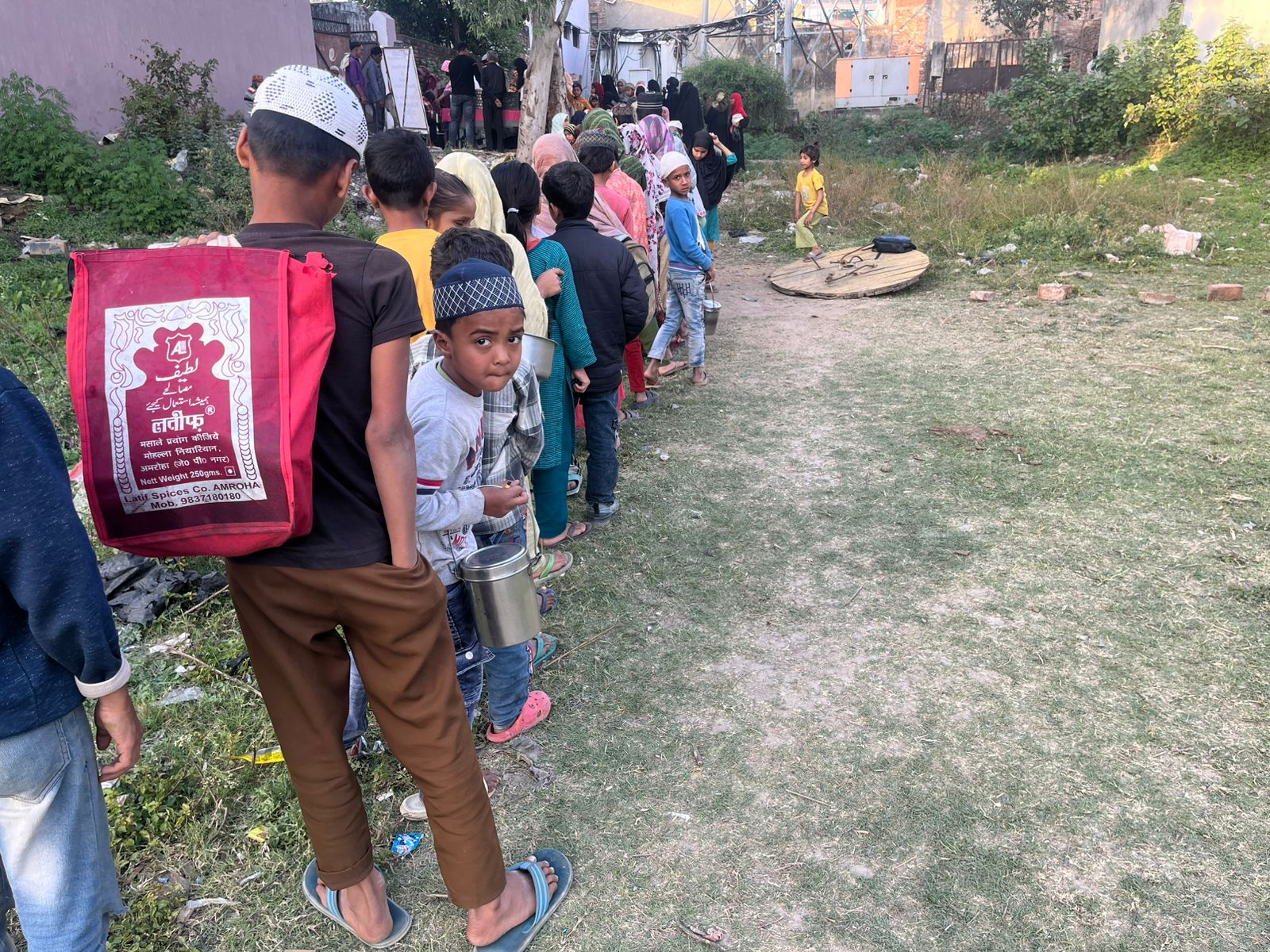
Your Zakat is given only to eligible Muslim recipients, and always in a way that makes them its owner. In our Community Kitchen, meals are not served at a shared table: each person receives a full plate of food, or has their own container filled, and takes it as their own. Zakat is never used for staff salaries, gas, packing, rent, transport or any other running cost.
Our kitchen serves everyone in need, of every faith, community and background, and turns no one away. Meals for those who are not eligible for Zakat are funded from Sadaqah and general donations, never from Zakat. Zakat is kept in a separate account.
Each meal costs ₹60, so your Zakat can feed many eligible people. Since our founding, we have distributed over 500,000 meals through our Community Kitchen.
Nisab — The Threshold for Zakat
Zakat becomes due when your wealth reaches the Nisab and a full lunar year passes over it. The Nisab is 87.48 grams of gold or 612.36 grams of silver.
If you own only gold, with no cash, silver or trade goods at all, the gold Nisab applies. If you own any cash, silver or trade goods, even alongside gold, your combined wealth is measured against the value of 612.36 grams of silver at today's price. Please check the current silver rate in your city, or use our Zakat Calculator.
What is Fitrana (Zakat al-Fitr)?
Sadaqat al-Fitr (Fitrana) is a separate obligation, due on Eid al-Fitr at the end of Ramadan, so that people in need can also celebrate Eid with dignity. Through Daan Foundation, Fitrana is ₹90 per person (wheat, the minimum), and we accept it only as complete ration kits.
Visit our Zakat al-Fitr page to learn who must pay it and to contribute.
Supporting Humanity Beyond Food
Education
Sponsoring education for underprivileged children
Medical
Healthcare access for those who cannot afford it
Clothing
Providing warm clothes and basic apparel
Marriage
Supporting marriage expenses for orphaned girls
Livelihood
Skills training and livelihood support
Transparency & Responsibility
We take our responsibility in handling Zakat funds with the utmost seriousness. Zakat is kept in a separate account and is tracked from the donor to the recipient. Zakat can be given only to a Muslim who is genuinely in need, meaning someone who does not own wealth equal to the Nisab beyond their basic needs, and who is not from the family of the Prophet ﷺ (Sayyid / Banu Hashim). Being a widow, an orphan or elderly does not by itself make a person eligible; they must also be in need.
Our financial records are maintained with complete transparency, and we provide detailed reports to donors upon request. We believe that trust is the foundation of Islamic charity, and we work tirelessly to honour the trust you place in us.
Working Only Within India
Daan Foundation operates exclusively within India, serving communities across the country. Your Zakat stays within India, helping your fellow citizens in need.
Frequently Asked Questions
What is Zakat?
Zakat is one of the five pillars of Islam. It is a mandatory charitable contribution of 2.5% of a Muslim's zakatable wealth above a minimum amount known as the Nisab.
Who must pay Zakat?
Zakat is obligatory for every sane, adult Muslim who owns wealth equal to or above the Nisab, beyond basic needs and debts, for one full lunar year.
What is the Nisab?
The Nisab is 87.48 grams of gold or 612.36 grams of silver. If you own any cash, silver or trade goods, your combined wealth is measured against the value of 612.36 grams of silver.
How is Zakat calculated?
Zakat is calculated as 2.5% of your total zakatable assets minus any debts. Zakatable assets include cash, savings, investments, gold, silver, and business inventory.
When should I pay Zakat?
Zakat is due once a full lunar year has passed since your wealth reached the Nisab. Many Muslims choose to pay during Ramadan.
Who can receive Zakat?
Zakat can be given only to a Muslim who is genuinely in need, meaning someone who does not own wealth equal to the Nisab beyond their basic needs, and who is not from the family of the Prophet ﷺ (Sayyid / Banu Hashim). Being a widow, an orphan or elderly does not by itself make a person eligible; they must also be in need.
Does any of my Zakat go to running costs?
No. Zakat is never used for salaries, gas, packing, rent, transport or other running costs. These are met from general donations.
Can I give Zakat for Iftar?
Zakat may be given for Iftar kits, because each kit becomes the recipient's property. However, we request that you give for Iftar as Sadaqah rather than Zakat. Our Iftar programme is generally funded by Sadaqah, so that it can reach as many fasting people as possible.
Please Note
This page gives general information based on Hanafi fiqh, with reference to rulings of Darul Uloom Deoband. It is not a fatwa. For your own situation, please consult a qualified mufti.
Ready to Pay Your Zakat?
Fulfil your sacred obligation today and transform lives across India. Your Zakat is a powerful act of worship that brings barakah to your wealth and hope to those in need.
Pay Your Zakat